Best Security Tools for AI-Generated Code in 2027
SHORT ANSWER
Choose SetRepo for a guided review of an AI-built app, GitHub's security tools for a GitHub-native workflow, Semgrep for configurable static checks, Snyk for code and dependency checks in your development tools, or Gitleaks for local secret scanning. These are recommendations by use case; we have not run a head-to-head detection benchmark.
By SetRepo team · Reviewed
We build and sell SetRepo. This comparison is written by its team, not an independent reviewer. Competitor coverage and pricing come from linked vendor documentation. The 2027 edition was prepared on November 10, 2026; it does not claim testing in 2027.
Tools compared
The best security tool for AI-generated code depends on what you need to inspect: application logic, database access, dependencies or leaked credentials. A scanner does not need to use AI to find problems in AI-written code. Start with your stack, your repository visibility and the evidence you need to fix an issue.
| Tool / source | Capabilities | Pricing / free limits | Limitations | Ideal user / setup |
|---|---|---|---|---|
| SetRepo | Source checks, secrets, dependencies and database rules; Deep adds selected AI review. | 100 free credits/month for Quick and URL scans. Deep: $2.99 once ($6.99 for large repos). Starter: $19.99/month. | AI review is paid and scoped. Findings need confirmation; no proof of runtime exploitability. | AI app builders wanting a report and fix prompts. Provide a repository or ZIP; choose a scan. |
| GitHub security tools | Dependabot, CodeQL code scanning and secret protection are distinct features. | Dependabot is available on all plans. Public repos get code and secret scanning; private advanced features require paid eligibility. Actions or AI usage can add costs. | Availability depends on repository visibility, plan and supported languages. | GitHub users wanting checks alongside pull requests. Enable each feature in repository settings. |
| Semgrep | Static analysis, custom rules and separate Supply Chain and Secrets products. | Free Edition: Code and Supply Chain, up to 10 repositories and 10 contributors. Teams Code starts at $30/contributor/month; other products priced separately. | Coverage depends on rules, language and edition; Secrets is not listed in the free bundle. | Developers who want to tune code checks. Connect GitHub/GitLab or configure the CLI. |
| Snyk | Code, dependency, container and infrastructure checks, with IDE and CLI integrations. | Free: 5 projects and 100 Code tests/month. Team starts at $25/month. Each product has its own test allowance. | Free usage is metered. Enterprise Evo capabilities are outside Free and Team. | Developers wanting feedback in their development tools. Connect projects or install an integration. |
| Gitleaks | Secret detection in files and Git history; supports local and pre-commit use. | Open-source CLI: $0 license cost. You maintain configuration and any CI infrastructure. | A secret scanner, not a dependency or application authorization scanner. | Solo developers wanting local secret checks. Install the CLI and select files or history. |
These are different scopes, not interchangeable products. A secret scan cannot establish whether one user can read another user's invoices. A source-code warning cannot establish whether a production database has the same policy. Budget for the checks your app needs, rather than choosing by the longest feature list.
How we evaluated the tools
We compared five options against a practical task: a solo developer has an AI-built web app, wants to review it before launch and needs a fix they can understand. We considered coverage, setup steps, free allowances, paid-plan boundaries, evidence in the report and the work needed to verify a fix. Our use-case recommendations are editorial judgments based on those criteria.
Evidence available: we inspected the SetRepo report screenshots shown below, ran three isolated SQL examples through SetRepo's static database-policy rule, and reviewed the linked official documentation and pricing pages on November 10, 2026. Competitor entries are documentation reviews; we did not run their hosted products or scan the same repository across all five tools. We have no comparable scan-time, recall or false-positive measurements, so we do not award scores or claim an overall detection winner.
The SQL check called the local _supabase_sql rule directly with an in-memory migration and a minimal finding collector. It did not run the file inventory, full scan pipeline, paid AI review or a live database. The raw results record the checker fingerprint and backend revision; each input is downloadable below. This is a small behavior check, not a representative benchmark.
| Download fixture | Open-policy findings | Interpretation |
|---|---|---|
| permissive-write.sql | 1 critical | FOR ALL with unconditional access was flagged. |
| owner-scoped.sql | 0 | No open-policy match; this is not a security certification. |
| public-read.sql | 1 medium; verify | Public SELECT was flagged for review, not treated as a confirmed write exposure. |
The useful distinction is between an unconditional write policy and a public read policy that might be intentional. Zero findings on the owner-scoped example means only that this rule did not match. Other policies, table privileges, ownership-column integrity and the deployed configuration still need review. See Supabase's RLS documentation for how policies and roles work together.
If you compare tools on your own app, use the same commit and scan scope. Record the enabled rules, product edition and exclusions. Include both a deliberately unsafe case and its intended fix. Count verified issues separately from unconfirmed findings, then test the change with two ordinary accounts. Raw alert counts alone reward noise and cannot tell you which tool protects your app better.
SetRepo
Strengths
SetRepo is our pick for AI app builders who want to move from a finding to a fix prompt. Quick scans use deterministic checks; paid Deep scans add AI review of selected code for access-control and business-logic issues. The supplied report shows source locations, explanations and fix prompts in one workflow. Repository and ZIP inputs support reviewing code exported from an AI builder.
Limitations
We own SetRepo, which creates a commercial interest in this recommendation. The strongest evidence here concerns one database-rule example, not broad superiority. Source checks can flag a pattern without proving that the current deployment is vulnerable. AI review has a defined scope and may miss issues. Review accuracy and limits, code handling and current pricing before choosing it.
Results
In the three local examples, the static rule flagged the unconditional write policy as critical, returned no open-policy finding for the owner-scoped policy, and marked the public-read policy medium with verification needed. The screenshots below come from a separate product report, not those synthetic fixtures. They illustrate the review workflow, including the distinction between headline counts and findings awaiting confirmation.

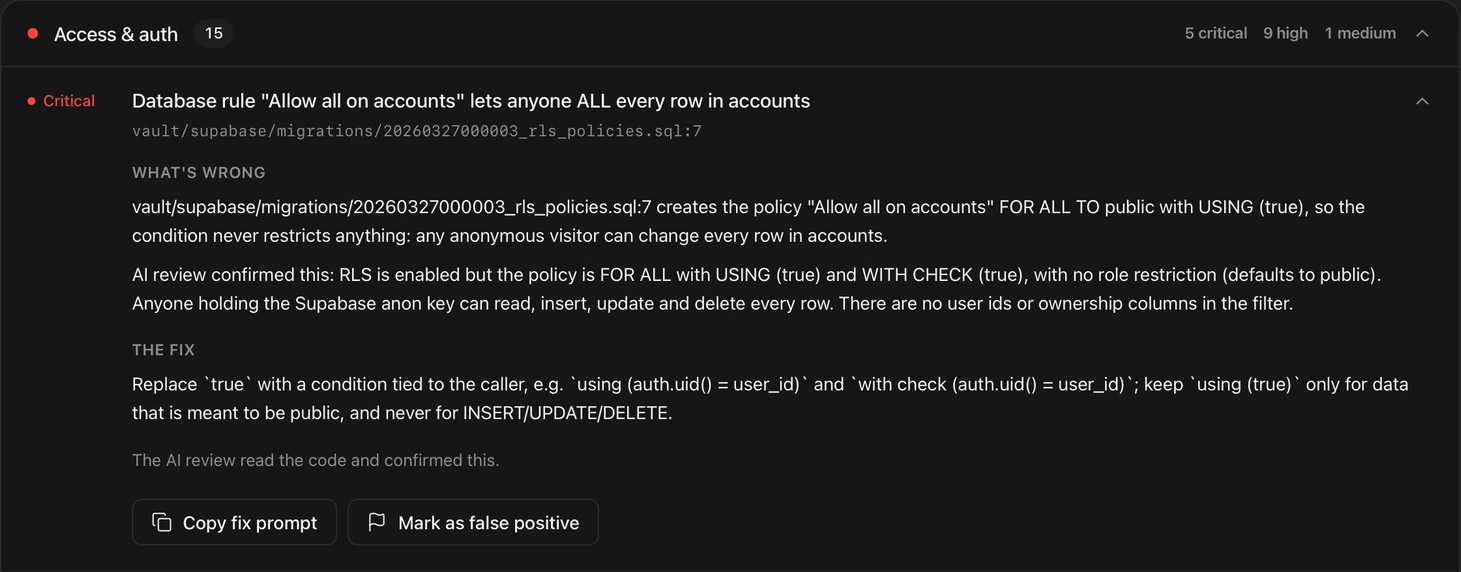
One drawback visible in the report is that findings still require interpretation: a severity badge or copied fix prompt is not a completed remediation. Check whether the migration is still active, adapt the change to your data model, and verify access after deployment. Our Supabase RLS guide explains the underlying issue.
GitHub security tools
Strengths
Consider GitHub if code review already happens in pull requests. Dependabot covers dependency alerts and updates; CodeQL code scanning and secret protection address different risks. GitHub's feature overview explains what is available on each plan.
Limitations
Check language support, repository visibility and licensing before enabling advanced features. Public repositories have free access to code scanning, secret scanning and dependency review; private advanced features require paid eligibility. Actions consumption and some AI features have separate billing considerations. See GitHub's billing documentation.
Results
Documentation review only; no local or hosted detection test in this comparison. Our recommendation is based on workflow fit. Use the repository security quickstart to check the features individually rather than assuming one toggle enables every protection.
Semgrep
Strengths
Consider Semgrep when you want configurable static checks and custom rules. Its hosted Free Edition lists Code and Supply Chain for up to 10 repositories and 10 contributors. The official pricing page separates the Code, Supply Chain and Secrets products.
Limitations
Rule selection, language support and edition affect coverage. The free bundle does not list Secrets. Paid Code starts at $30 per contributor per month, with separate product prices; check what is included before budgeting for the whole platform. Tuning rules and triaging findings are work to include in your setup decision.
Results
Documentation review only; no detection or setup-time measurement. We recommend it for control over static analysis, without claiming that it catches more issues than the alternatives. The quickstart walks through account connection and CLI setup.
Snyk
Strengths
Consider Snyk for code and dependency feedback in your development workflow. Its Free plan includes access to code, open-source dependency, container and infrastructure checks, with IDE, CLI and source-management integrations. See Snyk's plans and allowances.
Limitations
Free usage has separate limits per product: the reviewed plan lists 5 projects and 100 Code tests per month. Team starts at $25 per month. Do not assume that enterprise Evo capabilities are included in Free or Team, or that one product's allowance applies to all scans.
Results
Documentation review only; no detection test or measured triage time. The integration options make Snyk a candidate for developers who want feedback while working on code. Verify that its supported languages, product boundaries and test allowances fit your actual repositories.
Gitleaks
Strengths
Consider Gitleaks for focused local secret detection. Its open-source CLI scans files or Git history and can run as a pre-commit hook. A local command is useful when you want to choose the input yourself. Installation and usage are documented in the Gitleaks repository.
Limitations
The CLI has no license fee, but configuration, CI compute and reviewing matches take time. Secret detection does not replace dependency checks or application authorization testing. A detected secret also needs revocation or rotation; removing its text from a file does not invalidate it.
Results
Documentation review only; we did not measure secret recall in this comparison. Gitleaks is our focused option for a solo developer adding local secret checks. For the remediation workflow, read how to handle exposed secrets.
Which tool should you choose?
For solo developers choosing a security scanner in 2027, start with the cost of covering your app's actual risks and the effort required to act on findings. A free license can be useful; it does not eliminate setup or review work. These are our recommendations from the evidence above:
- You want a guided review of an AI-built app: try SetRepo's Quick scan, review a real finding, and decide whether paid Deep review adds value for your access-control or business-logic questions. Start with scanning a GitHub repository.
- You maintain a public GitHub project: start with the available GitHub dependency, code and secret protections. Check billing before adding metered features.
- You want to tune static checks: evaluate Semgrep's free edition against your languages and repository count before choosing paid products.
- You want code and dependency checks inside your development tools: evaluate Snyk's integrations and separate usage allowances.
- You only need a local secret check right now: use Gitleaks, rotate verified leaks, and add other checks when your scope expands.
For a small budget, a focused combination can make sense: dependency alerts, local secret detection and an application review before launch. Avoid paying for overlapping dashboards while leaving database permissions untested. Our guides to vulnerable dependencies, static analysis and the pre-launch security checklist can help you decide what is missing.
If you choose SetRepo, scan your repository, inspect the source evidence, apply a reviewed fix and rescan. Test that one user's account cannot access another user's private records. Treat a clean scan as one piece of evidence alongside those checks.